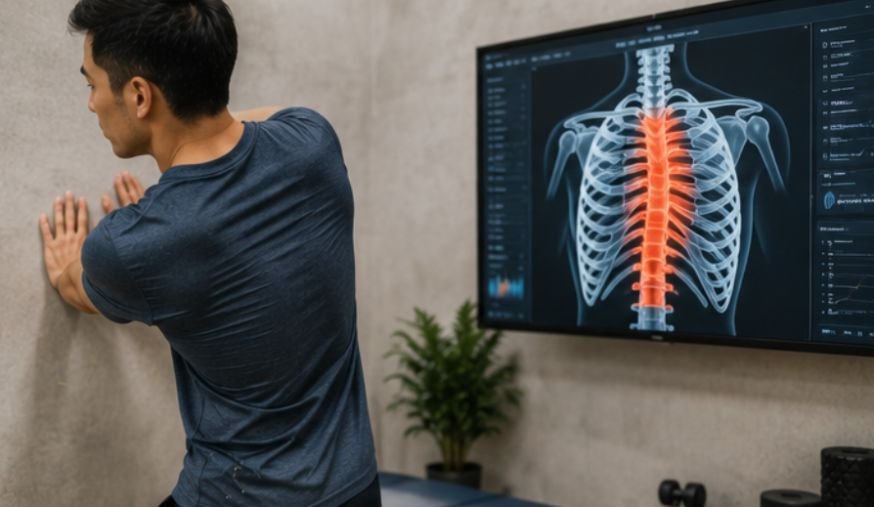
Long desk hours can leave your mid-back stiff and reluctant to move. A short routine of thoracic spine mobility exercises can restore smoother rotation, easier overhead reach, and better control. The goal is not dramatic bending. It is movement that supports daily life and training.
Meet Your Thoracic Spine
Your thoracic spine is the middle section of your back, running from the base of your neck to the bottom of your rib cage. Its twelve vertebrae support turning, reaching, bending, lifting, and breathing.
This region contributes rotation and extension. When it becomes stiff, the neck, shoulders, or lower back may compensate. That can affect overhead lifting, driving, desk work, and sports involving twisting.
Mobility Is More Than Stretching
Flexibility describes how far tissues can lengthen. Mobility describes how well you control movement through an available range. A passive stretch may help you reach a position, but mobility work helps you use it.
Why Your Mid-Back Needs Attention
Your upper back is the quiet teammate doing more work than it gets credit for. Thoracic spine mobility exercises help it rotate, extend, and support your shoulders without letting your lower back steal the whole show. Better movement can make reaching, lifting, sitting, and turning feel easier.
Stiffness often develops from spending too long in one position. Sitting, driving, laptop work, and repetitive workouts reduce movement variety. The answer is not having perfect posture. It is changing positions and giving your spine regular movement options.
Check Your Movement First
These checks reveal whether rotation or extension feels limited, but they do not provide a diagnosis.
Try Seated Rotation
Sit tall on a chair with both feet flat and your knees together. Cross your arms over your chest, keep your hips forward, and slowly turn your chest to one side. Repeat on the other side.
Notice whether one direction feels tighter or makes your hips shift. Retest after the routine. Smoother movement matters more than forcing a larger angle.
Test Overhead Reach
Stand near a wall with your ribs gently lowered. Raise both arms overhead without arching your lower back or lifting your shoulders.
Difficulty reaching upward may involve the thoracic spine, shoulders, chest, or lats. It does not prove one area is responsible, but it provides a useful baseline.
Extension Exercises
Extension drills help your upper back move backward with control. They are especially useful after long periods of leaning forward.
Foam Roller Extension

Place a foam roller horizontally on the floor and lie back so it rests under your mid-back. Support your head, keep your hips down, and gently arch over the roller.
Return to neutral and repeat five to eight times. Shift the roller slightly to reach another segment, but keep it away from your neck and lower back.
Child’s Pose With Reach
Kneel, sit your hips toward your heels, and reach both arms forward. Press your hands into the floor while allowing your chest to lower gently.
Take three to five slow breaths. Keep your abdomen lightly engaged. For a side stretch, walk both hands in one direction and breathe into the opposite rib cage.
Rotation Exercises
Rotation drills improve your ability to turn through the rib-cage area without twisting excessively through your hips or lumbar spine.
Open Book
Lie on your side with your knees bent to ninety degrees and your arms stacked forward. Slowly rotate your top arm and upper body backward while keeping your knees together.
Follow your hand with your eyes and return slowly. Complete six repetitions per side. You should feel a gentle opening through your chest and mid-back, not lower-back strain.
Thread The Needle
Start on your hands and knees. Slide one arm underneath your body until your shoulder moves toward the floor, then return and rotate that arm upward.
Complete six repetitions per side. Keep your hips still, exhale as you rotate, and stop before the movement becomes forced.
How To Use Thoracic Spine Mobility Exercises

Start with eight slow Cat-Cow repetitions to warm your spine, then perform six Thread the Needle repetitions per side. Continue with five foam roller extensions and six Open Book rotations per side.
Pairing this sequence with a morning stretching routine for flexibility can help reduce overnight stiffness, improve whole-body mobility, and make regular movement easier to maintain.
Finish with three breaths in Child’s Pose with Reach and eight Wall Angels. Move slowly enough to notice compensation, then repeat your seated rotation or overhead check.
Practise this sequence three to five times weekly. On busy days, complete one extension drill and one rotation drill for five minutes. Consistency matters more than perfection.
Fix Common Form Errors
Good technique keeps each movement focused, controlled, and useful.
Control Your Lower Back
Many people create false thoracic extension by arching the lumbar spine and flaring the ribs. Brace your abdomen and reduce the range if your lower back takes over.
During rotation, stop your pelvis from following your chest. A smaller movement from the correct area is better than a larger compensated movement.
Breathe And Slow Down
Holding your breath creates tension. Use a slow exhale as you rotate or move into a comfortable stretch, and keep your jaw and shoulders relaxed.
Gentle mobility work can also become part of your daily self-care ideas that cost nothing, especially when you need a simple way to reduce stiffness, reset your focus, and feel better without equipment or a paid class.
Avoid bouncing, pulling your neck, or chasing extreme range. Smooth repetitions improve control and make progress easier to notice.
Build Strength Around New Range

Mobility becomes useful when your muscles can control it. Add rows, face pulls, reverse fly variations, carries, and light overhead work to support the upper back and shoulders.
Choose manageable loads and maintain steady breathing. Strength does not replace mobility, but it helps you use new range during exercise, sports, and daily tasks.
Know When To Stop
Mild muscular tension may be acceptable, but sharp pain, numbness, tingling, dizziness, chest pain, or worsening weakness are reasons to stop. Seek professional guidance when symptoms follow an injury.
A physical therapist or qualified clinician can determine whether stiffness involves the thoracic spine, shoulder, neck, ribs, or another area. Mobility drills should support care, not replace assessment.
Frequently Asked Questions
1. How To Increase Mobility In Thoracic Spine?
Use thoracic spine mobility exercises combining controlled extension, rotation, side bending, breathing, and upper-back strengthening. Practise regularly and retest your movement instead of forcing an aggressive stretch.
2. What Are The Symptoms Of A Weak Thoracic Spine?
Possible signs include poor upper-back endurance, difficulty controlling overhead movement, frequent lower-back compensation, and trouble maintaining stable posture during lifting or prolonged sitting.
3. How To Loosen Up A Stiff Thoracic Spine?
Start with Cat-Cow, Open Book rotations, foam roller extensions, and Child’s Pose with Reach. Move slowly, breathe normally, and stop before discomfort becomes sharp.
4. How To Self Mobilize Thoracic Spine?
Use a foam roller, chair-backed extension, or controlled floor rotation. Keep pressure away from your neck, avoid forceful cracking, and focus on gentle, repeatable movement.
Let Your Upper Back Join The Party
A stiff mid-back does not need punishing stretches. The best thoracic spine mobility exercises train extension, rotation, breathing, and control. Start with a self-check, choose drills matching your restriction, and retest afterward. Better movement comes from patient practice, not one dramatic session.
Leave a Reply